Guides
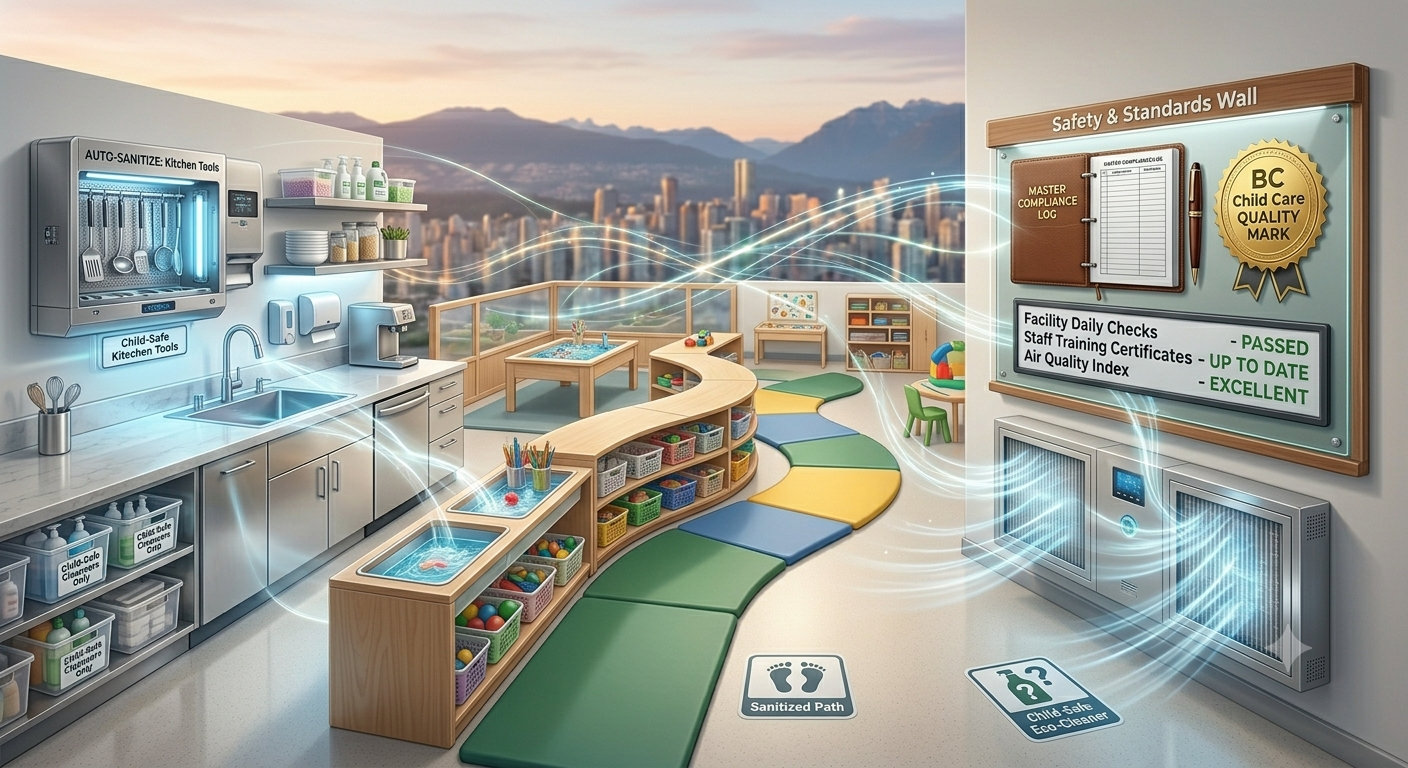
A Licensing Officer can visit your Metro Vancouver child care centre at any time. Learn the cleaning and sanitation details that shape your inspection — and how to stay ready every day, not just when you’re expecting a visit.
If you run a licensed child care centre in Metro Vancouver, you operate under the watchful eye of your regional health authority. Licensing Officers — from Vancouver Coastal Health, Fraser Health, and the other regional bodies — can visit your facility for a routine inspection or in response to a concern, and they don’t always call ahead.
For Daycare Directors and owners, that uncertainty is a quiet source of stress. You’re already juggling staffing ratios, programming, parent communication, and a dozen other responsibilities. The last thing you want is a preventable cleanliness issue showing up on an inspection report.
Here’s the reassuring part: sanitation is one of the most controllable parts of licensing readiness. With the right cleaning partner and the right habits, your facility can be inspection-ready every day — not just when you’re expecting a visit.
At GetCleanify, we clean daycares, preschools, and early learning centres across the Lower Mainland, and we build our protocols around the realities of a licensed environment.
Child care licensing exists to protect a uniquely vulnerable group. Young children have developing immune systems, spend much of their day on the floor, and explore the world by putting things in their mouths. In that context, hygiene isn’t a cosmetic concern — it’s a core health and safety requirement.
That’s why an inspection looks well beyond whether the floors are swept. Officers pay attention to the systems and surfaces most likely to transmit illness between children.
These are among the highest-risk zones in any centre. Best practice is for changing surfaces to be disinfected between every use, with diapering areas kept physically separate from any space where food is prepared or served. Dedicated handwashing — for both children and staff — needs to be convenient and consistently stocked.
Shared toys are germ highways. A defensible approach uses a “mouthed-toy” rotation: once a toy has been in a child’s mouth, it goes into a designated bin for sanitizing before returning to circulation. The sanitizer used on toys should be safe for food-contact surfaces, because that’s effectively what they become.
Sleep mats and cots are personal-contact surfaces used daily. They need regular sanitizing and a system that keeps one child’s mat from touching another’s. Carpets and play mats at floor level deserve genuine attention too, since that’s where the children actually live.
Tables sanitized before and after meals, low door handles, cubbies, light switches at toddler height — the unglamorous high-touch points are exactly where transmission happens, and exactly what a thorough clean targets.
There’s an old compliance saying: if it wasn’t documented, it wasn’t done. You might run a spotless centre, but if you can’t show when the toys were last sanitized or how often the changing tables are disinfected, you’re relying on goodwill rather than evidence.
Many centres still track this on a clipboard by the door — easy to forget, easy to lose, and impossible to analyze. GetCleanify’s tech-enabled checklists log each completed task with a timestamp, so if an officer asks when a specific area was last serviced, you can pull up a clear record instead of guessing.
Daycares face a genuine tension: you need real disinfection to stop outbreaks, but you can’t coat a child’s environment in harsh chemicals. We resolve it with eco-certified disinfectants — including accelerated hydrogen peroxide formulations — that carry recognized kill claims but break down into benign components and won’t leave irritating residue at floor level.
The secret isn’t a stronger smell; it’s correct dwell time. Our teams are trained to let disinfectants sit for the time they actually need to work, which is how you get hospital-grade results with child-safe products.
The biggest mistake we see is treating cleanliness as something to ramp up only when an inspection feels imminent. Because visits can be unannounced, the only reliable strategy is to be ready all the time.
That’s the heart of our “set it and forget it” promise. With vetted, local, in-house teams and a rigorous color-coded system, your centre holds a consistent standard every day — so an inspection is just another day, not an emergency.
You became a child care provider to nurture kids, not to lie awake worrying about inspections. A professional, well-documented cleaning partnership takes one major variable off your plate and lets you focus on the children and families you serve.
Book a walkthrough with our team. We’ll assess your centre through a licensing lens and propose a sanitation plan that keeps you continuously ready.
Our commercial cleaning experts can help customize a maintenance plan that fits your business needs perfectly.
Get a Free Quote